Lixel K2 available to rent now.Request availability
From the blog · How-to
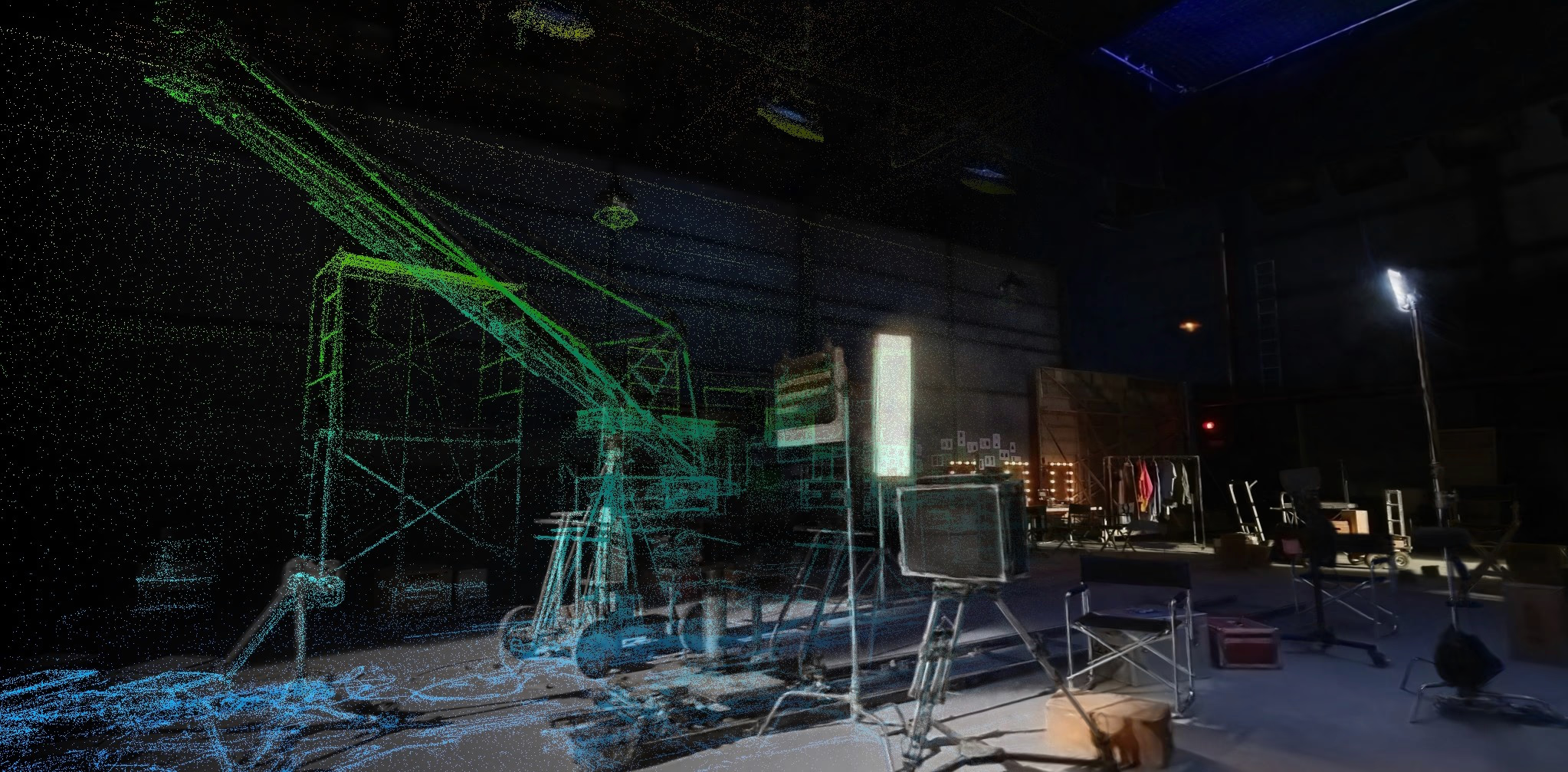
How to capture a venue in 3DGS with rented XGRIDS gear.

A how-to on renting XGRIDS equipment and producing a browser-viewable 3D Gaussian Splatting scene of an event venue in Singapore yourself.

Photoreal 3D Gaussian Splatting capture of a venue

This is an illustrative field note, not a client case study. It uses no client names, dates, or results — only a realistic picture of how the workflow tends to run. Volumet rents the equipment; the scene is produced by the renter or their partner.

When your venue needs to be seen, not measured

Say you want a photorealistic, explorable model of a venue — something a client can walk through in a browser to plan a production, not a survey-grade point cloud. The priority is visual fidelity and atmosphere: lighting, materials, and the feel of the space.

That is exactly where 3D Gaussian Splatting fits. Rather than a clean geometric mesh, 3DGS reconstructs a soft, lifelike scene from captured views — ideal for venues, sets, and spaces where the experience matters more than millimetre accuracy.

Photoreal where mesh falls short

Traditional meshes struggle with reflective, transparent, and fine-detailed surfaces — stage lighting, glass, foliage, fabric. 3DGS handles these gracefully, producing scenes that look convincing from any angle and load smoothly in a browser or XR headset. For a venue, that means a walkthrough a client can actually explore, not a technical deliverable that needs interpreting.

  • Photorealistic, explorable scenes
  • Handles reflective and complex surfaces well
  • Browser and XR-friendly delivery
  • Great for venues, sets, and marketing

From walkthrough to scene

The capture itself is a four-step rhythm, and none of it depends on Volumet beyond the rental and optional onboarding:

  • Plan. Identify hero viewpoints and the path a viewer should take; plan even coverage and consistent lighting.
  • Capture. Walk the venue with rented XGRIDS equipment — PortalCam for dedicated 3DGS, or a K2 capture feeding the pipeline.
  • Process. Reconstruct the 3DGS scene through the XGRIDS / LCC CyberColor workflow.
  • Deliver. Publish a browser-viewable scene or export for XR and virtual production.

What your venue scene delivers

Typical outputs from a 3DGS venue capture you run, subject to device, software, and processing workflow:

  • 3DGS scene — a photorealistic Gaussian Splatting scene, explorable in a browser or XR.
  • Point cloud — an underlying point cloud where spatial reference or measurement is also needed.
  • Digital twin seed — a visual foundation for digital twin and previsualisation experiments.
Related pages

Keep exploring.

3DGS venue capture, answered.

What is 3D Gaussian Splatting?
3DGS is a rendering technique that reconstructs a photorealistic, explorable 3D scene from captured imagery and spatial data. It produces smooth, lifelike views well suited to venues, real estate, and virtual production.
Can the Lixel K2 produce 3DGS scenes?
XGRIDS workflows support 3D Gaussian Splatting use cases depending on the device, capture method, and processing workflow. The PortalCam is purpose-built for 3DGS, and K2 captures can also feed 3DGS pipelines.
Is this based on a real venue project?
No. This is an illustrative field note describing a realistic 3DGS venue workflow. It uses no client names, dates, or results.
What can I do with a 3DGS scene?
3DGS scenes can be explored in a browser or XR, used for virtual production and previsualisation, marketing walkthroughs, and digital twin experiments, subject to your processing and delivery setup.

Planning a venue capture?

Tell us about the space, the look you are after, and your delivery target. We will confirm which XGRIDS rental fits.

Request rental availability