A digital twin your team actually owns.
A navigable, measurable record of the building as it stands, point cloud, hosted walkthrough and optional BIM model, delivered as a handover package in your name, not locked to a vendor.
FromS$3,500
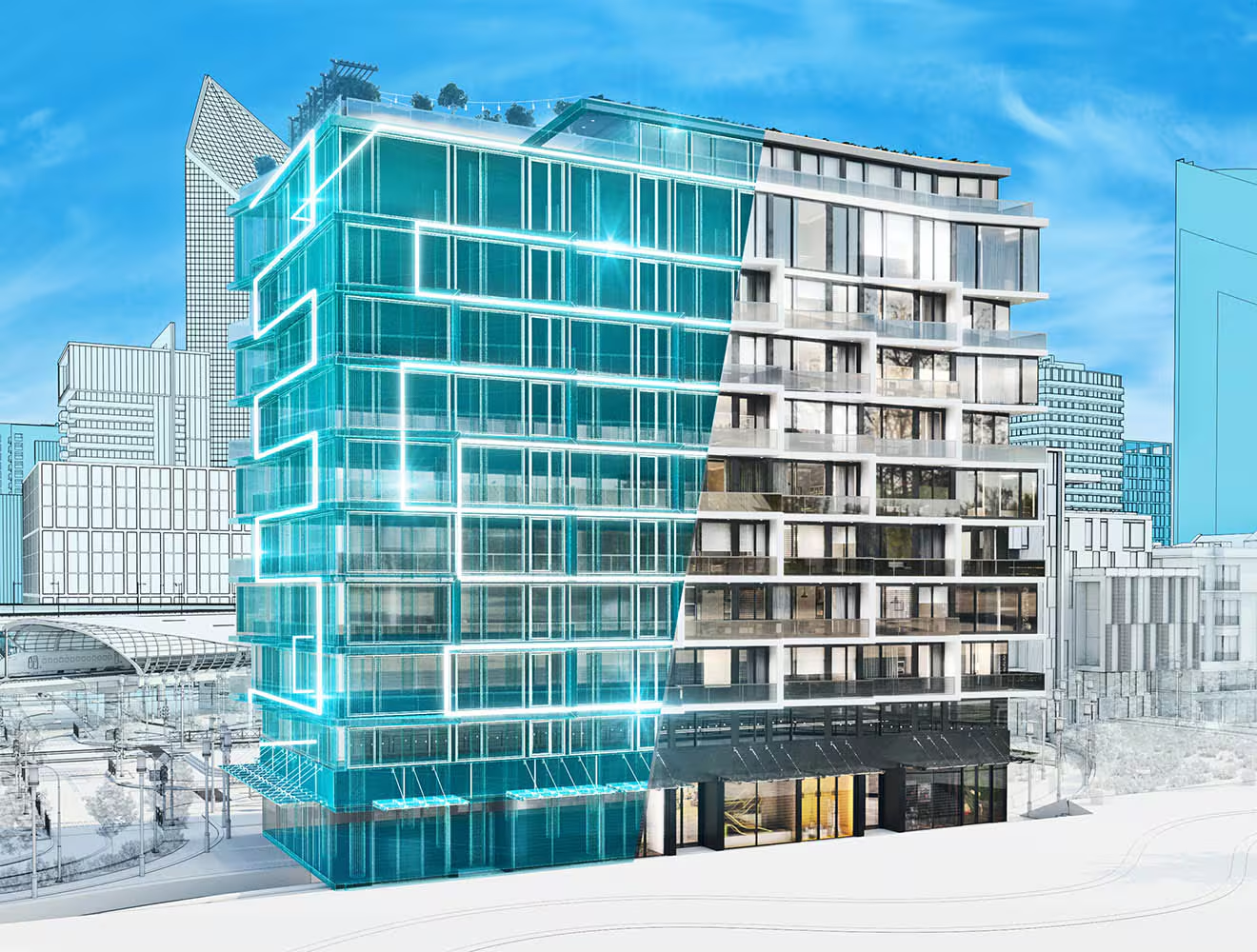 Digital twin · navigable record
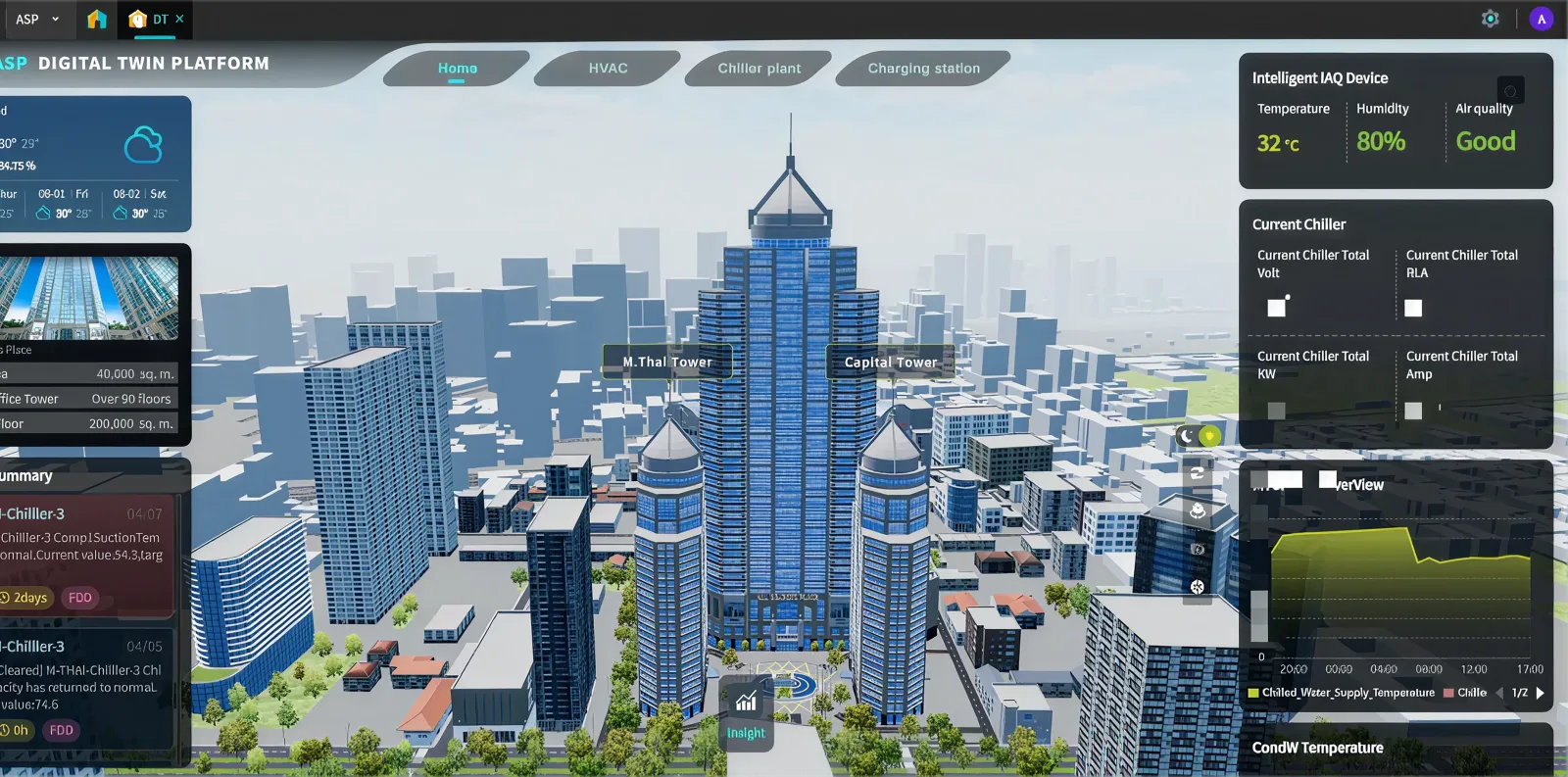 Twin platform · live data
What a delivered twin actually is
The phrase covers a lot of marketing. What we deliver is concrete: a registered point cloud of the asset, a viewable scene your stakeholders can walk through: a hosted Matterport tour or a 3DGS scene, and, where operations need it, a Revit or IFC model via Scan-to-BIM. Measurement happens in the point cloud at the accuracy of the underlying capture, stated with conditions. The presentation layers are for communication, not statutory measurement.
Everything else marketed under the term, sensors, live telemetry, analytics dashboards, sits on top of that spatial record and is built by your own systems team or a platform vendor. What we guarantee is the spatial foundation being accurate, documented and yours.
The three layers, and which you actually need
The measured layer is the point cloud: the record everything else is verified against. Every twin has one, because without it the twin cannot answer a dimension question.
The viewable layer is what non-technical stakeholders open. A hosted tour with tags and floor plans suits facilities and leasing teams; a 3DGS scene suits venues and marketing where photorealism carries the value. Some assets get both.
The modelled layer is Revit or IFC: needed when the twin has to feed design work, asset registers or a CAFM/CMMS system with structured objects rather than geometry. It is the most expensive layer and the one most often bought before it is needed, so we ask what system will consume it before recommending it.
Hosting and handover
The handover package puts the accounts, files and hosting in your name: the point cloud in open formats (E57, LAS), the tour under your own subscription, the model files unencumbered. If hosting lapses years from now, the underlying data is still yours. We say this up front because the alternative, a twin that dies with a vendor contract, is common.
Settled in writing before capture, who owns the account, who pays hosting and on what cycle, what happens at renewal, who may share links externally, and what the exit looks like. That last one is the test of any twin proposal. Ask any vendor what you keep if you leave; if the answer is a login, you do not own a twin.
What it is used for
- Facilities documentation: one source of truth for fit-outs, maintenance and tenant queries.
- Remote access to venues and plant rooms without site visits: useful for contractors quoting works.
- A measured baseline before and after works, including dilapidation and reinstatement evidence.
- Feeding future submissions: the same dataset supports as-built drawings later.
- Leasing and venue sales: a space that can be toured without a site visit shortlists faster.
- Onboarding and training for teams who need to know a building before they walk it.
- Insurance and asset records at a defined point in time.
Keeping it current
A twin captured once is a record of a date. That is genuinely useful, most owners have nothing comparable, but decide up front how it stays current. The realistic options: recapture on a cycle (annual for facilities, monthly for construction progress), recapture on trigger events (fit-out completion, tenancy change, major works), or accept it as a fixed baseline and label it with its date.
Partial recapture is usually the economical answer: rescan the floor or plant room that changed, register it into the existing dataset, and keep the rest. Because the original control and registration are documented, that is a short visit rather than a fresh survey.
What it is not
It is not an IoT platform, a BMS integration or an analytics product, unless you connect one. It is not a substitute for statutory measurement: presentation layers are communication assets and the point cloud carries the accuracy figure with its conditions. And it is not a living model that updates itself: buildings change, and the twin only changes when someone captures the change.
Choosing the right depth for the asset
Overspecifying a twin is the common failure. A single-tenant office needing tenant queries answered wants a tour plus a cloud. A hospital plant room wants a cloud and tight capture of the services. A venue selling event space wants photoreal 3DGS and floor plans. A portfolio landlord wants consistency across buildings more than depth in any one. Tell us who will open the twin weekly, and what question they will open it to answer, that determines the scope better than any feature list.
Turnaround and cost drivers
Cost is driven by asset size and number of spaces, the layers included, capture accuracy, whether a model is in scope and at what LOD, and the recapture cadence. Delivery for a single building is typically two to four weeks for cloud and viewable layers, longer where a model is included. Multi-asset portfolios are phased and priced per building once the template is set.
Tell us the asset and who needs to use it to get a quote.
Questions to ask any twin vendor
Five questions separate a twin you own from a subscription you rent. What exactly do we receive as files? The answer should name formats, E57, LAS, RVT, IFC, OBJ, not features. Whose account hosts it, and what happens at renewal? If the hosting is theirs with no transfer path, the asset is not yours.
What is the measured accuracy, and under what conditions? A twin quoted with a bare millimetre figure and no condition attached is a marketing number. Relative and absolute accuracy are different, and the difference matters for how the twin can be used.
How does it get updated, and what does an update cost? Buildings change. If the only update path is a fresh full survey, the twin will quietly go stale within two years. Partial recapture registered into the existing dataset should be an option and should be priced.
What happens if we stop paying? The honest answer is that hosted viewing layers go offline and open-format files stay yours. Any answer softer than that is worth reading twice.
We answer all five in writing before capture, because they are the questions clients wish they had asked at the first renewal rather than at the fifth.
Where twins pay for themselves
The honest answer is that twins pay back through avoided visits and avoided rework rather than through anything visible on a dashboard. Four places that shows up.
Contractor quoting. A fit-out, maintenance or M&E contractor who can measure and see the space before pricing produces tighter numbers and fewer variations. Owners who run several works packages a year usually recover the twin cost here first.
Tenant and stakeholder queries. Facilities teams spend a surprising amount of time answering questions that are geometric: will it fit, where does that run, how high is that ceiling. Answering from the record instead of from a site walk is the daily saving.
Handover and staff turnover. Institutional knowledge about a building leaves with people. A measured record with tagged assets does not, which matters most for plant rooms, risers and anything installed before the current team arrived.
Dispute and claim evidence. A dated, measurable record of condition before and after works is the cheapest insurance a building owner can hold, and it is worthless if created after the argument starts.
What does not pay back is depth nobody uses: a fully modelled MEP twin for a building whose team only ever opens the tour. Scope to the questions your people actually ask, and extend later from the same archived dataset when a new question appears.
Foundation first, layers by audience.
Who opens the twin, and to answer what. Determines layers, accuracy and spaces in scope.
Accounts, hosting, payment cycle and exit terms settled in writing before capture.
Laser scan of the asset, plus tour or 3DGS capture on the same visit where those layers are included.
Cloud registered and QA’d; viewable scene built and tagged; model produced where in scope.
Files, accounts and documentation transferred to you, with a recapture plan if you want one.
From S$3,500 per building.
Point cloud, hosted walkthrough and optional model, delivered in your name. Indicative prices for Singapore; your quote is fixed in writing.
A registered point cloud and a hosted, navigable walkthrough of one building or venue, handed over in your name.
A Revit model at LOD 200, built from the same capture.
- 3DGS walkthrough+S$1,200
- Virtual tour+S$300
- Recapture on a scheduleQuoted
Multi-building portfolios are phased and priced per building once the template is set.
- Point cloud and hosted walkthroughS$3,500
Recapture on a schedule is quoted.
What you keep, in what format.
| Layer | Format | Notes |
|---|---|---|
| Registered point cloud | E57 · LAS / LAZ · RCP | The measured record. Open formats, no vendor dependency. |
| Hosted walkthrough | Matterport tour + share links | Under your own account: see virtual tours. |
| Photoreal scene | 3DGS scene files + browser viewer | Where photorealism carries the value: see Gaussian splatting. |
| BIM model | RVT · IFC | Where a system will consume structured objects: via Scan-to-BIM. |
| Drawing set | DWG · PDF | Plans, elevations, sections and RCPs cut from the same dataset. |
| Mesh | OBJ · FBX · glTF | For visualisation, XR and engine workflows. |
| Documentation | Capture date, method, accuracy with conditions, coverage note, control record. |
Ask any twin vendor what you keep if you stop paying. The answer should be files, not a login.
Related work, services and guides.
Common questions.
What is a digital twin, in practice?
A navigable, measurable 3D record of the asset, point cloud, viewable scene, optional BIM model, packaged for your team. It is a documentation asset, not an IoT platform, unless you connect one.
What do we receive?
The point cloud in open formats, the viewable scene, any models, and accounts in your name, so the twin survives vendor changes.
Can we measure from it?
From the point cloud, yes, at the stated capture accuracy. Presentation layers are for communication only.
Who pays for hosting, and what happens if we stop?
Agreed in writing before capture. Hosted tours sit under your subscription by default; if hosting lapses, the point cloud, drawings, models and mesh files are still yours because they are open formats you hold.
How do we keep the twin up to date?
Recapture on a cycle, on trigger events like a fit-out or tenancy change, or accept it as a dated baseline. Partial recapture, one floor or plant room registered back into the existing dataset, is usually the economical route.
Do we need the BIM model layer?
Only if a system will consume structured objects: an asset register, a CAFM/CMMS, or a design team. If the need is documentation and remote access, the cloud plus a viewable scene is the better-value scope.
Can you twin several buildings in a portfolio?
Yes, and consistency matters more than depth in that case. We set a capture and delivery template on the first building and repeat it, priced per building.
How long does it take?
Typically two to four weeks for cloud and viewable layers on a single building; longer where a model is in scope. Portfolios are phased.
Can a twin feed our CAFM or CMMS system?
Where a model layer is in scope, yes, as structured objects with the parameters your system expects. Settle the data schema with your systems team first; geometry without the right data fields will not import usefully.
Can you twin only part of a building?
Yes, and it is often the right call. Plant rooms, risers, lettable floors or a single campus building can be captured on their own, then extended later into the same dataset.
Who can access the twin, and can we control that?
You do, because the accounts are yours. Viewing layers support public, unlisted and restricted access; point clouds and models are files you hold and distribute as you choose.
How does this differ from just having drawings?
Drawings answer known questions; a twin answers unasked ones. The measured record lets someone check a dimension, see a condition or brief a contractor without attending site, and drawings can still be cut from the same dataset when a sheet is needed.
What are some digital twin examples?
Typical uses: a facilities team measuring a ceiling void from their desk before sending a contractor; a fit-out consultant pricing works from a walkthrough without a site visit; an engineer checking clearances in a factory point cloud before a new line goes in. The technology is the same each time; the depth is sized to what that team needs.