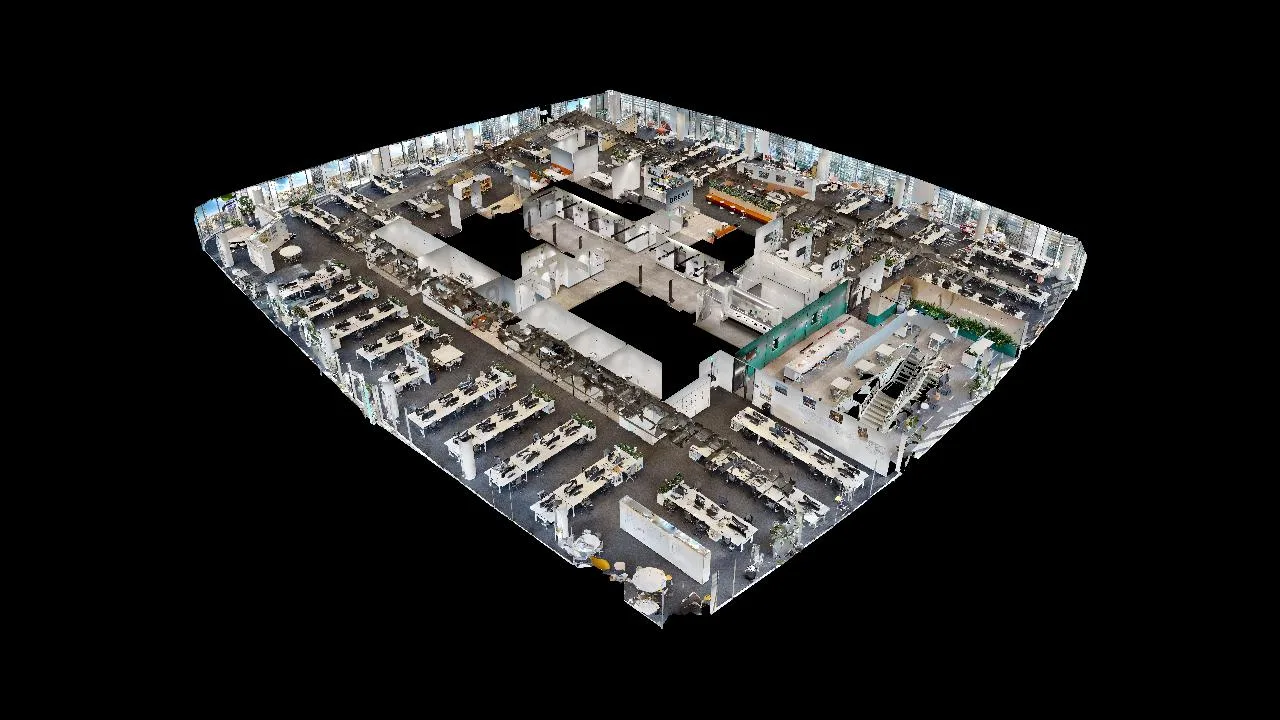
An events team wanted a photorealistic, explorable model of a Singapore venue: something their own clients could walk through in a browser to plan a production, not a survey-grade point cloud. The priority was visual fidelity and atmosphere: lighting, materials, and the feel of the space.
That is exactly where 3D Gaussian Splatting fits. Rather than a clean geometric mesh, 3DGS reconstructs a soft, lifelike scene from captured views, ideal for venues, sets, and spaces where the experience matters more than millimetre accuracy. Technically, the scene is built from millions of oriented, semi-transparent Gaussian primitives, each carrying colour and view-dependent shading, optimised until rendering them reproduces the captured views. The result behaves less like a CAD model and more like a photograph you can move through, which is precisely the register a venue walkthrough needs.
When is 3DGS better than a mesh?
Traditional meshes struggle with reflective, transparent, and fine-detailed surfaces: stage lighting, glass, foliage, fabric. A mesh has to commit every surface to a hard polygon and a texture, so a chandelier becomes a blob and a glass balustrade becomes either invisible or opaque. 3DGS handles these gracefully, producing scenes that look convincing from any angle and load smoothly in a browser or XR headset. For a venue, that means a walkthrough a client can actually explore, not a technical deliverable that needs interpreting. The trade runs the other way for measurement-first work, where a project needs dimensioned as-built data, a point cloud or hybrid workflow is the better lead, and 3DGS becomes the presentation layer on top.
- Photorealistic, explorable scenes
- Handles reflective and complex surfaces well
- Browser and XR-friendly delivery
- Great for venues, sets, and marketing
From walkthrough to scene
The capture is a four-step rhythm:
- Plan. Identify hero viewpoints and the path a viewer should take; plan even coverage and consistent lighting.
- Capture. Walk the venue with PortalCam for dedicated 3DGS, or a K2 capture feeding the pipeline.
- Process. Reconstruct the 3DGS scene through the LCC CyberColor workflow.
- Deliver. Publish a browser-viewable scene or export for XR and virtual production.
The planning step is where 3DGS capture differs most from a scanning mindset. A splat scene is reconstructed from views, so the walk is choreographed around how the space will be looked at, not just what exists in it. Coverage should be even and generous: the reconstruction can only be sharp from angles it has actually seen, so hero areas, the stage line, the entrance reveal, the seating bowl, get orbited deliberately rather than passed once. Lighting consistency matters for the same reason. The scene bakes in the lighting it was captured under, so we locked the venue’s lighting state before starting and avoided mixing states mid-capture; if the house look is the sell, capture under the house look.
The two capture routes serve different briefs. PortalCam is the dedicated 3DGS instrument, built around image quality for splat reconstruction. A K2-based capture brings LiDAR geometry into the pipeline alongside the imagery, which is the route we take when the same visit also needs to yield measurable spatial data. Either way the processing runs through the LCC CyberColor workflow: ingest the capture, reconstruct and optimise the splats, trim the scene boundary, and publish to a viewer link that opens in a browser with nothing to install, which is what makes the deliverable land with non-technical clients.
Two lessons from the capture discipline side are worth passing on. First, people and moving objects are to a splat scene what glass is to a scanner: anything that moves between views becomes a smeared ghost in the reconstruction, so we scheduled the walk for an empty venue and paused whenever staff crossed the frame. Second, resist the urge to rush the boring middle of the room. It is tempting to spend the whole capture on the hero angles, but the viewer will wander, and the difference between an impressive demo and a usable deliverable is that the unglamorous connecting spaces hold up too. Running it again, the only change would be budgeting more time for exactly those in-between passes.
What the venue scene delivers
Typical outputs from a 3DGS venue capture like this, subject to device, software, and processing workflow:
- 3DGS scene: a photorealistic Gaussian Splatting scene, explorable in a browser or XR, and usable for virtual production, previsualisation, and marketing walkthroughs.
- Point cloud: an underlying point cloud where spatial reference or measurement is also needed, exportable in standard formats for the tools that consume them.
- Digital twin seed: a visual foundation for digital twin and previsualisation experiments.
The split matters when scoping: the 3DGS scene answers “what does the venue feel like from here?”, while the point cloud answers “will the truss clear the ceiling?”. A capture plan that knows which questions the client will ask decides the method before the visit, which is why we ask what the scene is for before quoting it.
Want your venue explorable in a browser?
The same deliverable suits venues, showrooms, galleries and sets: anywhere a client needs to understand a space before they stand in it. We plan the viewer’s path, lock the lighting, orbit the hero areas, and publish the scene to a link that opens anywhere with nothing to install. Read what Gaussian Splatting covers, see where it fits real estate and venue work, or tell us about the space and the look you are after. We reply with scope and a quote within one business day.