3D scanning for projection mapping
We scan the wall, facade or object you are projecting on and deliver a straight-on image to scale, a 1:1 line drawing of every edge and opening, and a mesh. Your content team builds on the real surface, not a photo.
FromS$800
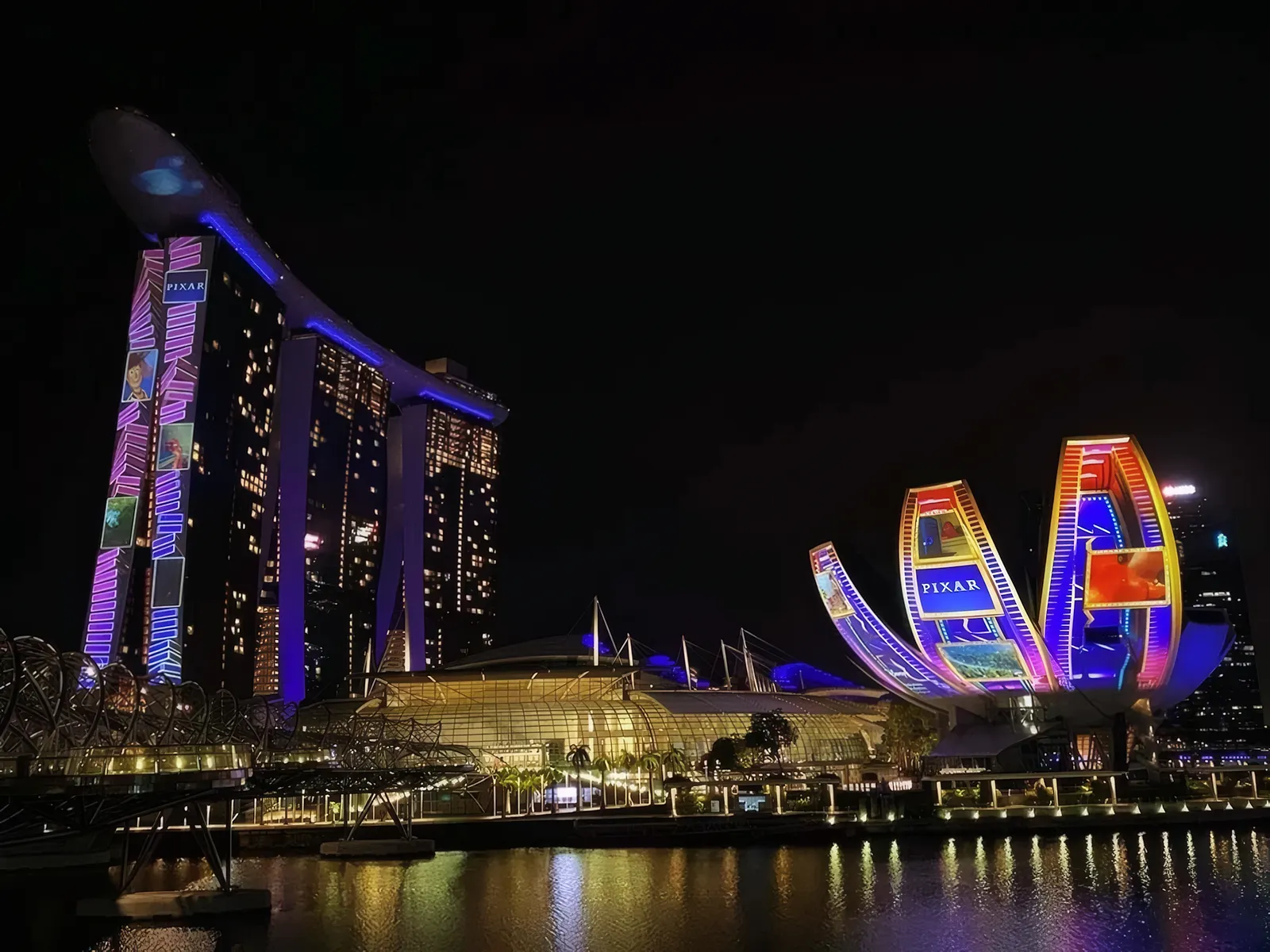 Facade mapping · Marina Bay
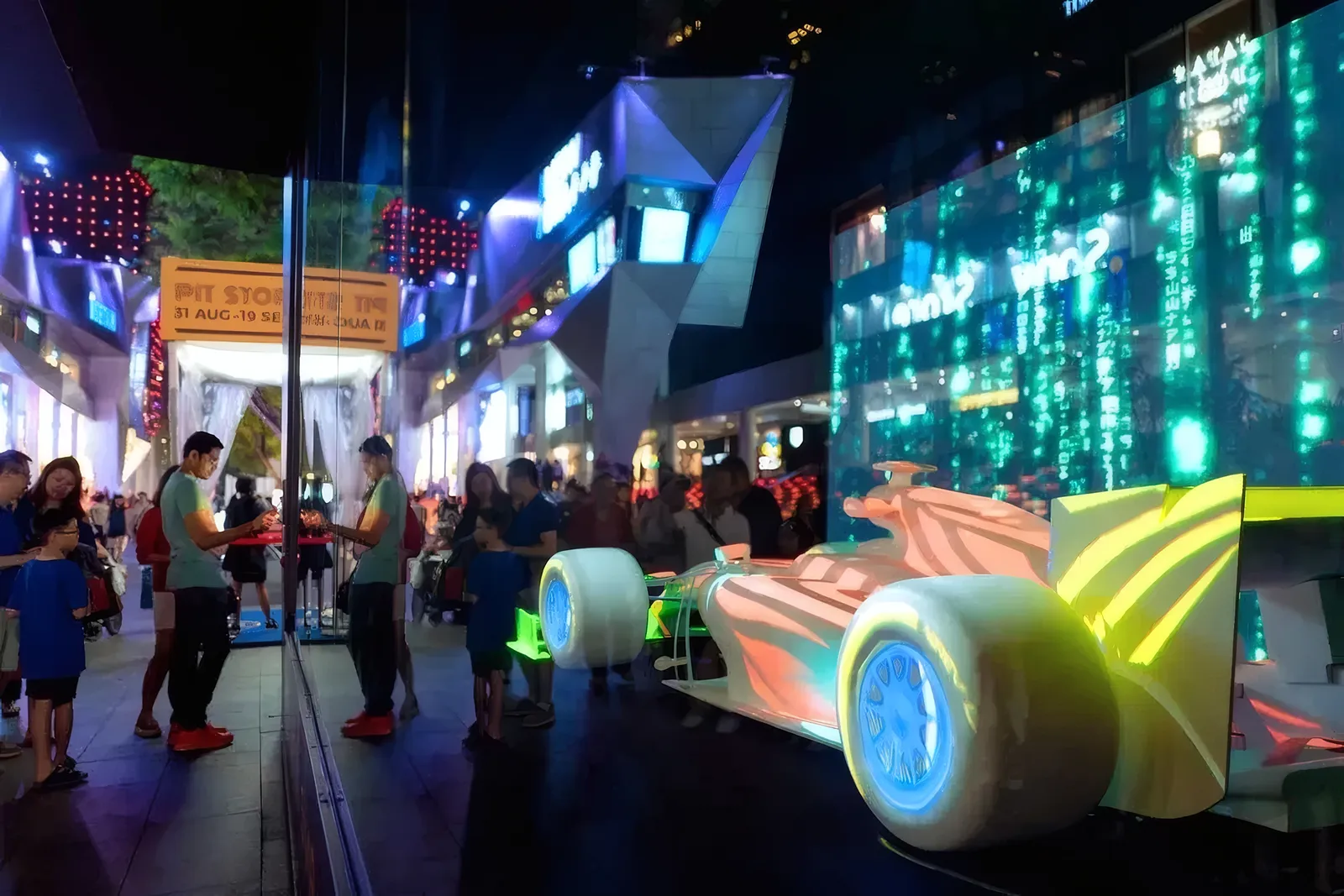 Object mapping · Orchard Road
What you receive
A straight-on image of the surface at a fixed scale, a line drawing at 1:1 of every edge, joint, moulding and opening, a mesh, and the point cloud behind them. The image and the line drawing are what most content teams start from: drop them into After Effects, Photoshop, Resolume or MadMapper and build the content to the lines. The mesh is for 3D content and previs; the point cloud is there to measure anything else on site.
Why not a photo
A photo is taken from one point. On a 15 m wall shot from the floor, the top comes out smaller than the bottom, windows lean in, and anything that sticks out (a cornice, a keystone, a pilaster) shifts against the wall behind it. Straightening the photo in software gets it close, never exact, and the error shows the moment content is meant to sit inside a window frame.
The straight-on image is built from the scan, so every millimetre on the wall is the same number of pixels, top to bottom and edge to edge. The line drawing comes from the same data, so the template, the lines and the stone agree.
A recent wall
In November 2026 we scanned the stone end wall of a heritage atrium in the Civic District for a projection mapping artist. The wall is 11.05 m wide and 14.70 m high, with an arch at the foot and three windows under pediments above. It was scanned in one visit with a Lixel K2 handheld scanner, with the public walking through.
The artist received, within three days:
- A straight-on image of the wall at 2 mm per pixel, 5,522 x 7,350 px, with a mask of the openings.
- A line drawing of every groove, joint, moulding and opening at 1:1, in DXF, SVG, PDF and PNG.
- The wall as a mesh of 353 separate blocks, textured with the straight-on image, in OBJ and FBX.
- The point cloud: 76.7 million points in full, and a 1 cm version that opens on a laptop.
- A 3D scene of the atrium to look around in the browser.
The scan also found a 23 to 30 cm strip at the left edge of the wall that runs behind a pilaster and cannot be seen or projected on from the floor. It is marked on the drawing as blocked, so no content was made for it.
Surfaces we scan
- Building facades and heritage walls for festivals and launches.
- Interior walls, domes, ceilings and atriums for exhibitions and immersive rooms.
- Stage sets and event backdrops, before the show and after a rebuild.
- Objects: cars, sculptures, building models and products for object mapping.
- Retail windows and lobbies for brand activations.
Projector positions
The same scan covers the space in front of the surface, so projector questions can be answered from it: throw distance from each candidate position, mounting points on balconies and trusses, the angle to the surface, and what stands in the way. We measure; your AV team chooses the projectors and the blending.
Working on site
Handheld scanning needs no power, no lighting and no cables, so it fits into the hour before a venue opens or after it closes. A single wall is usually under an hour. People walking past are removed from the point cloud. For a facade on a public road, we work from the pavement and, where the upper storeys need it, add a drone.
Honest limits
Glass, polished metal and very dark surfaces scan poorly; they are marked on the drawing, and they rarely make good projection surfaces anyway. The scan records the surface on the day: if a banner, scaffold or set piece is added later, it is not in the data. And we deliver the survey, not the content or the projection.
Turnaround and cost
From S$800 for a single wall or object; larger and multiple surfaces are priced from their size and the files your team needs. Point cloud and a first straight-on image within a few days; the full line drawing and mesh usually within a week. Send photos of the surface and your content deadline to get a quote.
How it works
Which surface, what your team works in, and the file the template should start from.
Handheld SLAM of the surface and the space in front of it, out of hours if needed.
The surface seen square-on at a fixed scale, with a mask of the openings.
Every edge, joint and opening drawn at 1:1; the mesh split into blocks if you want it.
Image, DXF, SVG, PDF, OBJ, FBX, LAS and E57, plus a 3D scene to look around in.
From S$800 per surface.
Indicative prices for Singapore. Larger walls, whole rooms and several facades are quoted from photos; your quote is fixed in writing.
Scan of a single wall, facade bay or object, with the straight-on image to scale, the 1:1 line drawing and the point cloud.
- Size of the surface
- Number of surfaces or facades
- Mesh split into blocks or one object
- Upper storeys that need a drone
- Out-of-hours access
- On site, one wallUnder an hour
- Point cloud and first imageWithin days
- Line drawing and meshAbout a week
Send photos of the surface, its rough size and your content deadline.
This one depends on the site, so we price it from the details. Send them and we come back within one working day.
Priced case by case once we have the site details.
Deliverables
| Deliverable | Format | Used for |
|---|---|---|
| Straight-on image | PNG at a fixed scale | Content template in After Effects, Photoshop, Resolume or MadMapper |
| Line drawing at 1:1 | DXF · SVG · PDF · PNG | Edges, joints, mouldings and openings in millimetres, with and without dimensions |
| Mesh | OBJ · FBX | 3D content, previs and UV mapping; split into blocks or as one object |
| Point cloud | LAS · E57 | Measuring anything else on site, projector positions and throw distances |
| 3D scene | Browser link | Showing the client or the team the space without a site visit |
| Blocked areas | Marked on the drawing | Strips hidden behind columns or pilasters that cannot be projected on |
Related services and guides
FAQ
What do you deliver?
A straight-on image of the surface at a fixed scale (2 mm per pixel on a building wall), a line drawing at 1:1 of every edge, joint, moulding and opening in DXF, SVG and PDF, a mesh in OBJ and FBX, and the point cloud in LAS and E57. Most content teams start from the image and the line drawing.
Why not just photograph the wall?
A photo is taken from one point, so the top of a tall wall comes out smaller than the bottom, and anything that sticks out shifts. The straight-on image is built from the scan, so every millimetre on the wall is the same number of pixels, top to bottom. Your template lines up with the stone.
How long do you need on site?
A single wall or facade is usually under an hour with handheld SLAM. A whole room or several facades take longer. We can scan before opening or after closing.
Can you scan while the venue is open?
Often yes. Handheld capture needs a walkable path and no power or lighting. Visitors walking past are removed from the point cloud, though the cleanest scan is always an empty space.
How accurate is it?
Handheld SLAM is within about 1 cm relative over 10 m, which is finer than a projected pixel on a building-sized wall. Where a job needs tighter, we add tripod scan positions on the surface itself.
Do you tell us where to put the projectors?
We measure where they can go: throw distances to the surface, mounting points, and what blocks the view. Projector choice and blending stay with your AV or projection team.
Can you scan objects and sculptures as well as walls?
Yes. A car, a stage set, a sculpture or a building model is scanned the same way and delivered as a mesh your content team can UV map or use in a 3D package.
What about dark, shiny or glass surfaces?
Glass and polished metal scan poorly and are marked on the drawing. They usually make poor projection surfaces anyway, so it helps to know early.
How fast can we get the files?
The point cloud and a first straight-on image within a few days; the full line drawing and mesh usually within a week. Tell us your content deadline and we deliver in the order your team needs.
Can you come back after the show to check alignment?
Yes. A second scan registered to the first shows exactly what moved, which helps when a show is re-staged or a temporary set is rebuilt.