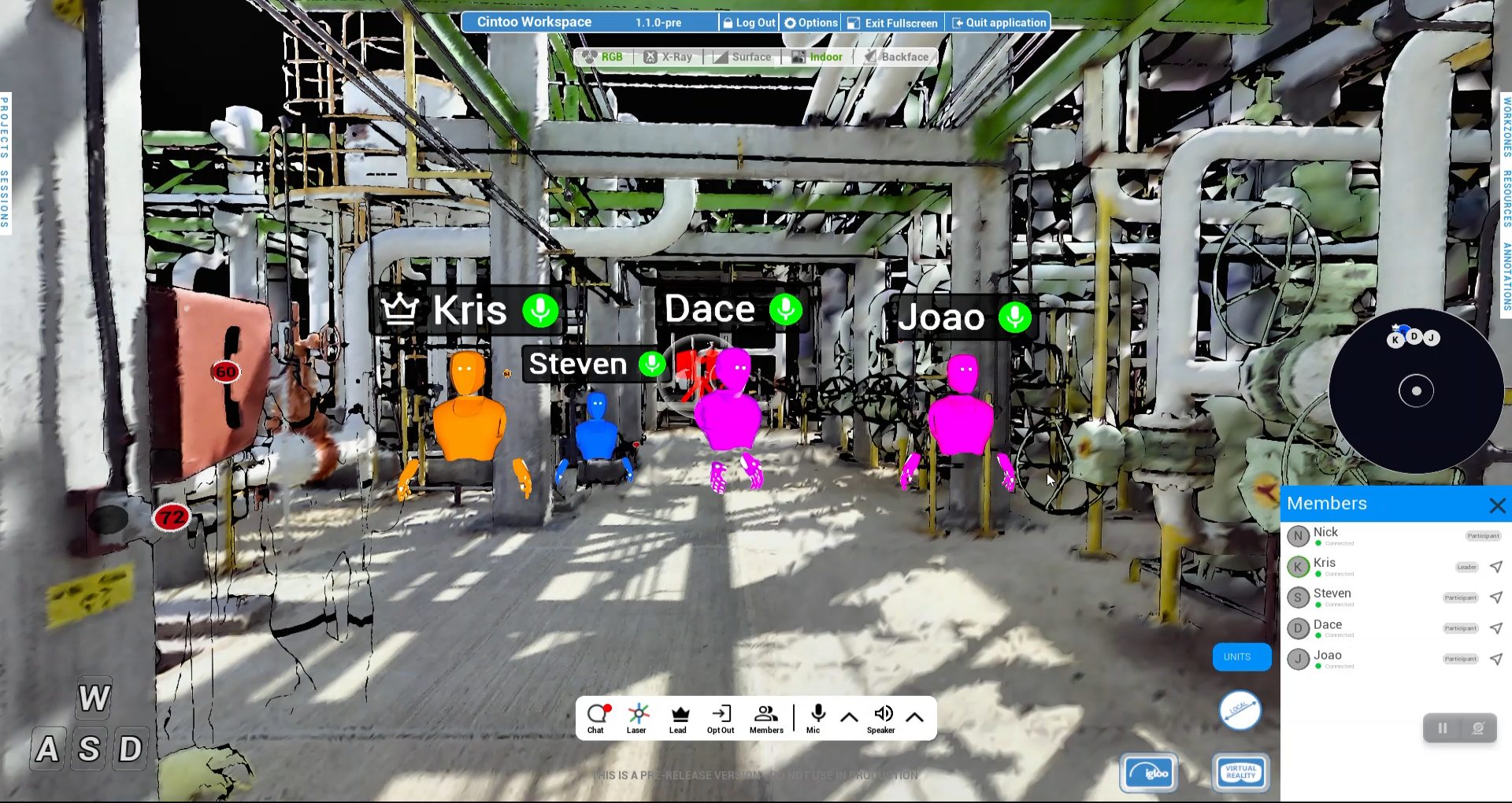
Cintoo has launched Cintoo Workspace, a real-time collaboration environment that lets project teams meet inside digital twins streamed from 3D scan data rather than in a screen-shared video call. The announcement was made at R-CON 2026 in Boise, Idaho, and reported by Geo Week News. Participants join from a desktop, a VR headset or an immersive room. One person leads the review, others can opt in to be guided while remaining free to move around, and the leader can pull everyone to a single location when something needs attention. Shared annotations, measurements and issue features sit inside the twin, so the decision is recorded where the problem is. The application runs on Unreal Engine and is cloud-connected to the Cintoo platform, working on scan data from terrestrial and mobile scanners, 360 cameras and drones, alongside BIM or CAD models.
Why this matters for as-built review in Singapore
Most as-built disputes we see do not come from bad scanning. They come from the gap between the scan and the decision. The scan gets delivered as a point cloud or an E57 file, someone opens it on a workstation, screenshots a few views into a slide deck, and the actual conversation happens three weeks later in a meeting room with a projector and no dimensional context.
That gap has a cost. It shows up as a second site visit to confirm something that was already captured. It shows up as a variation claim argued from memory rather than from a measurement. It shows up as a consultant in another country who has never seen the site being asked to sign off on a drawing they cannot verify.
A shared session inside the scan data compresses that. If the architect, the QP, the main contractor and the M&E coordinator can all stand in the same corridor in the point cloud, look at the same ceiling void, and take the same measurement, the meeting produces a decision rather than an action list.
For Singapore specifically, three things make this more relevant than it would have been five years ago. First, more projects are scanning at multiple stages rather than once at handover, so there is more data to review and more reason to review it together. Second, CORENET X has pushed submission workflows toward structured digital exchange, which raises the expectation that the as-built record is something you can interrogate, not just archive. Third, teams are more distributed. A developer's project manager may be in Singapore, the design architect in London, the façade consultant in Shanghai. Getting all three into a scan is cheaper than getting all three onto a site.
What changes in practice
The honest answer is that the collaboration layer changes the meeting, not the scanning. You still need the scan captured, registered and hosted before anyone can walk through it.
Where it does change things:
| Task | Before | With a shared scan session |
|---|---|---|
| Clash or deviation review | Screenshots in a slide deck, argued from memory | Measured in the twin, in front of everyone |
| Remote consultant sign-off | Drawing markup, then a site visit to confirm | Confirm in session, record the annotation |
| Progress verification | Photo report, periodic site walk | Compare current scan to previous scan in the same session |
| Handover walkthrough | Physical walk with a snag list | Walk the twin, issue logged against a coordinate |
What it does not change:
- It does not make a poorly registered scan usable. If your scans are not tied to a common coordinate frame, a shared session just lets more people see the misalignment at once.
- It does not replace a site visit for anything requiring physical access, destructive inspection, or a statutory inspection by a Qualified Person. A twin shows what was captured on the day of scanning.
- It does not fix a scan that was captured to the wrong specification. If the review needs to decide whether a pipe is 20 mm off, the scan has to have been captured at a density and registration quality that supports that question. No collaboration tool recovers detail that was never captured.
- It does not remove the need for a defined scope. A shared 3D space with no agenda is a tour.
Our view
The interesting part of this announcement is not the VR. It is the guided collaboration model. Most multi-user 3D tools fail because everyone wanders off and the meeting dissolves. Structuring it as a site walk, with a leader, opt-in guidance, and a regroup mechanism, is a small design decision that addresses the actual reason remote reviews do not work.
The trade-offs are real, though.
Data volume and hosting. Streaming high-fidelity scan data to multiple concurrent users is bandwidth-hungry. On a Singapore project with a few hundred registered scans, the question is not whether the platform can render it but whether your office connection and the hosting region make it usable in a live meeting. Ask where the data is hosted and what the latency looks like from Singapore before you commit a client meeting to it.
Who holds the licence. This is a platform subscription, not a service. If the scan was delivered to you as a file, you may not have a Cintoo seat, and the contractor who does may not want to give you one. Decide early who owns the review environment, because that person controls the record of decisions.
The record of the meeting. Annotations and issues created inside a twin are only useful if they export. Ask what format the issue log comes out in and whether it lands in the tool your project already uses for snagging. A decision recorded in a platform nobody else opens is not a decision.
It is not a substitute for specification. We have written before about how automatic scan-to-BIM segmentation misses accuracy in ways that only show up later. The same caution applies here. A convincing walkthrough of a twin is not evidence that the twin is accurate. The accuracy claim lives in the scan specification and the registration report, not in the viewer.
Who should care: owners and developers running multi-stage scanning on large projects, main contractors coordinating M&E in congested services zones, and project teams with design consultants outside Singapore. If your project is a single-stage scan of a small fit-out, this is probably more process than you need.
What to do next
If you are commissioning scan data and want it usable in a shared review, the specification matters more than the platform. Three things to put in the brief:
- A stated registration method and a target accuracy that names the conditions it holds under: equipment, range, and how the scans are tied together. A bare millimetre figure means nothing without those.
- A coordinate frame agreed with the project's design model, so the twin and the BIM sit in the same space.
- A naming convention for levels, zones and rooms that survives the handover to whoever runs the review.
We deliver 3D laser scanning and Scan-to-BIM with our own team and equipment, and we can hand over registered data in formats that feed platforms like this one. If you would rather run the capture yourself, our equipment rental line covers the Lixel K2, K1 and L2 Pro, PortalCam, Matterport Pro3 and Leica BLK360 G2, and you produce your own outputs from there.
For a project where the review meeting is the bottleneck rather than the scanning, talk to us about what the data needs to support before you choose the tool.